I do not think the right question is whether a Mac Studio can replace a ChatGPT or Claude subscription. Local AI is not a cheaper version of cloud AI; it is a different operating model, and the Malaysian pricing makes that distinction even clearer.
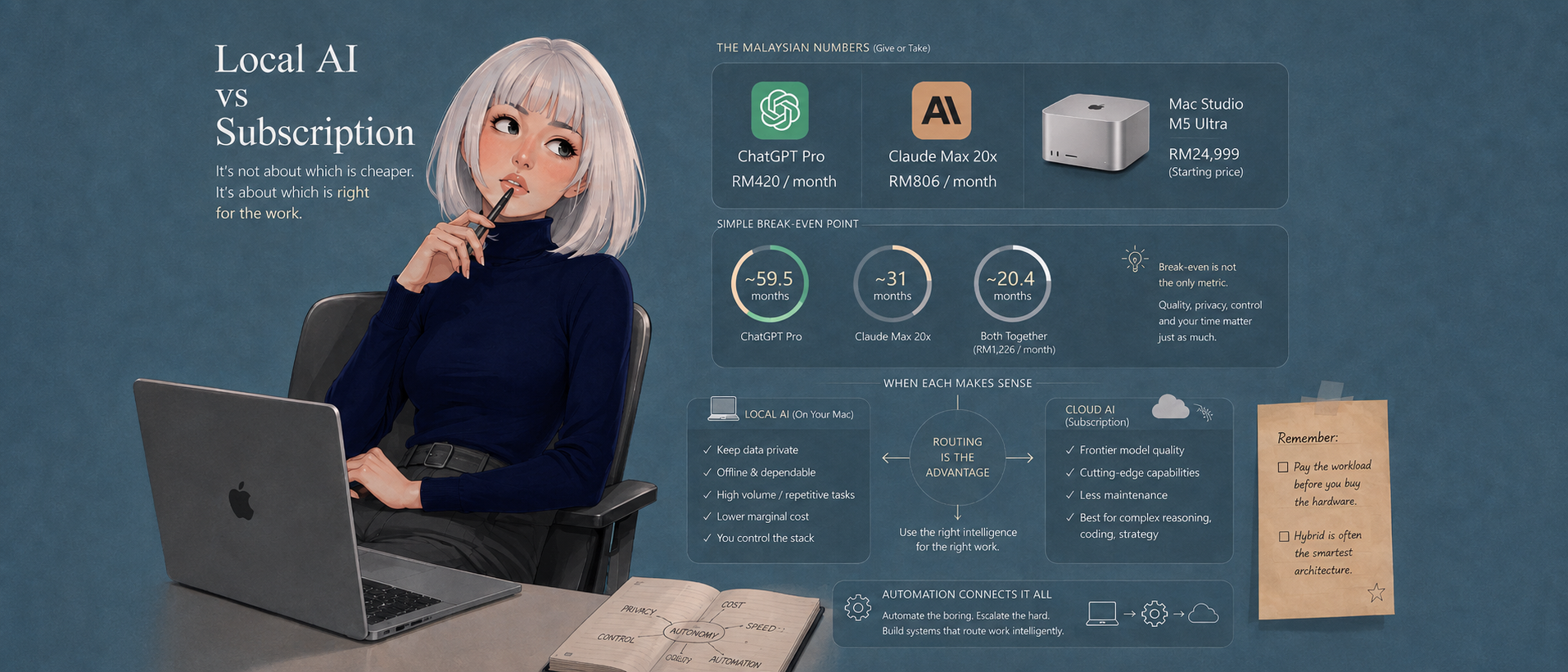
ChatGPT Pro currently costs me about RM420 per month. Claude Max 20x works out to roughly RM806 per month after currency conversion. An M5 Ultra Mac Studio, meanwhile, starts at RM24,999 in Malaysia.1
Put those numbers beside each other and the obvious “just buy the hardware” argument becomes much less obvious.
In Malaysia, the break-even point moves a long way out
If a RM24,999 Mac Studio genuinely replaced ChatGPT Pro at RM420 per month, the simple break-even point would be almost 60 months.
That is roughly five years.
Replacing Claude Max 20x at around RM806 per month gets the number down to about 31 months, or two and a half years.
If you are paying for both services, around RM1,226 per month combined, the theoretical break-even falls to roughly 20 months.
| What the Mac replaces | Monthly spend | Simple break-even |
|---|---|---|
| ChatGPT Pro | RM420 | ~59.5 months |
| Claude Max 20x | ~RM806 | ~31 months |
| Both | ~RM1,226 | ~20.4 months |
This is where comparisons between local AI and cloud subscriptions often become misleading.
The table assumes the Mac Studio can provide the same thing.
It cannot.
ChatGPT Pro is not a box containing a model. Claude Max is not simply rented GPU time. Both give access to hosted infrastructure, continually updated frontier models, interfaces, multimodal capabilities, tools and a provider responsible for keeping the service running.
The Mac Studio gives you compute.
Those are not equivalent purchases.
The break-even point is not when the hardware costs less than the subscription. It is when the workload you can move locally is valuable enough to justify owning the infrastructure.
Local AI buys control more than it saves money
Local AI means running an open-weight model on hardware you control rather than sending each request to a provider-hosted model.
That gives you something cloud AI cannot completely provide: ownership of the execution environment.
Apple’s M5 Ultra Mac Studio now starts at RM24,999 in Malaysia and supports substantially larger unified-memory configurations for workloads such as local large language models.1 2
Memory matters because large models have to fit into available memory along with their context and runtime overhead. That is one reason a machine with more memory can sometimes be more useful for local AI than a faster configuration with less memory.
But the reason I find local AI interesting is not benchmark performance.
It is what ownership lets you do.
Sensitive company documents can stay inside your environment. Repetitive processing can run without a per-token charge. Internal systems can invoke a model thousands of times without someone worrying that an experiment has suddenly created a large API bill.
And you are not entirely dependent on one provider deciding which model, usage limit or feature remains available next month.
That matters.
But it still does not make local AI equivalent to frontier AI.
A RM24,999 machine still has a labour bill
This is the cost that disappears from most hardware comparisons.
Running local models has become dramatically easier. Tools such as Ollama and LM Studio can turn what once required specialist knowledge into something a technically curious person can have running fairly quickly.
But someone still has to operate it.
Someone chooses the models.
Someone tests whether a 32B model is actually good enough for the task.
Someone discovers that the larger model which benchmarks better is suddenly too slow for a real workflow.
Someone updates Ollama, changes a quantisation, deals with storage, monitors memory and works out why an automation stopped getting sensible responses after a model update.
If that person is me experimenting on a weekend, I might treat that cost as zero.
A business should not.
Once local AI becomes infrastructure, the person maintaining it is part of the AI bill.
This is why the Malaysian numbers are useful.
At RM420 per month, I would find it very difficult to justify buying a RM24,999 Mac Studio purely to “replace ChatGPT Pro”. Five years is a long payback period for technology that is moving this quickly.
Even Claude Max at roughly RM806 per month does not automatically make the purchase obvious.
The calculation gets interesting only when there is a workload behind it.
The economics change when AI becomes infrastructure
Imagine an SME using AI occasionally.
The owner writes proposals, analyses documents, asks questions and uses an AI assistant during the day.
For that business, RM420 per month for access to a frontier model may be remarkably cheap.
There is almost nothing to maintain.
Now imagine another company processing thousands of documents, classifying enquiries, extracting information from invoices, summarising internal records and running AI inside several automation workflows.
That company has a different equation.
The important number is no longer the ChatGPT subscription.
It is the total amount of inference the business consumes.
A company might have ChatGPT Pro, Claude Max, several employees using AI subscriptions and another few hundred or few thousand ringgit flowing through APIs every month.
Suddenly RM24,999 is being compared against a much larger operating expense.
More importantly, the AI is no longer merely something employees chat with.
It has become infrastructure.
That is where local compute starts making sense to me.
The better architecture may be local first, cloud when necessary
I also would not try to make the Mac Studio replace everything.
The more useful design is probably hybrid.
A local model can handle boring, high-volume work:
- document classification
- field extraction
- lead tagging
- summarisation
- data cleaning
- first-pass drafting
- internal knowledge retrieval
- routine agent tasks
None of those necessarily require the smartest model available.
They need a model that is good enough, cheap to run repeatedly and appropriate for the data involved.
Then ChatGPT, Claude or another frontier model handles the work where intelligence is actually scarce: difficult reasoning, strategy, complex coding, unusual edge cases and important external-facing output.
An AI adoption strategy then becomes less about choosing a winner between ChatGPT, Claude and local models.
It becomes a routing problem.
Which work deserves frontier intelligence? Which work deserves local control? Which work simply needs cheap inference?
That is a much more useful question.
I would buy the workload before I buy the Mac
The M5 Ultra Mac Studio makes local AI increasingly practical. Apple itself now talks about running large language models and frontier-class models on-device, and the M5 Ultra can scale to hundreds of gigabytes of unified memory.1 2
I still would not start there.
I would start with subscriptions.
Use ChatGPT. Use Claude. Build workflows with APIs. Find out what people actually use. Watch where the API spending grows. Find the data you are uncomfortable sending outside the business.
Then look at the workload that emerges.
If a company discovers that it is spending RM2,000, RM3,000 or RM5,000 every month running predictable AI jobs, a RM24,999 machine becomes a very different proposition.
If privacy requires certain information to stay local, the financial break-even may not even be the primary consideration.
But if the entire argument is that RM420 a month for ChatGPT Pro feels expensive, I would keep the RM24,999 in the bank.
The interesting change is that businesses now have a choice that barely existed a few years ago.
They can rent intelligence.
They can own compute.
Or they can build a system that knows when to use each.
I suspect the third option will be the one that matters.