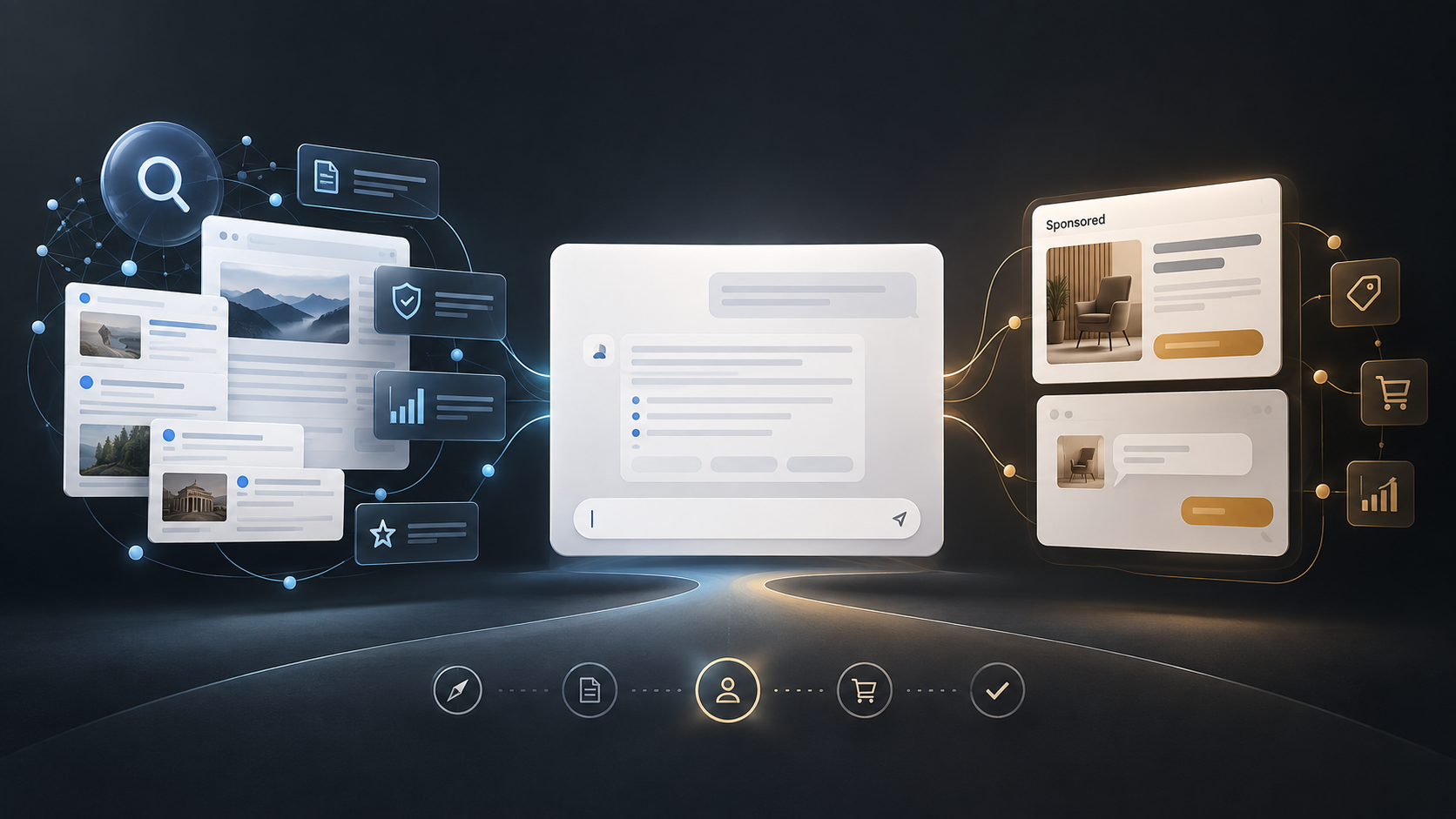
AI search is still SEO because the core job remains helping the right people find, understand and trust a business. But the arrival of ChatGPT Ads in Malaysia means that “being the answer” and “buying a place beside the answer” are beginning to coexist in the same conversation.2
That does not make SEO irrelevant. It makes the old division between organic search and paid media less useful. A buyer can ask ChatGPT to compare options, encounter a sponsored business, interrogate that business through a sponsored agent, and then decide whether the company looks credible enough to contact. OpenAI is testing that sponsored-agent experience with select US advertisers, while its advertising rollout now includes Malaysia and Singapore.2 3
The practical question for an SME is no longer whether to call this SEO, GEO, AEO or something else. It is whether the business can be found, assessed and trusted at every point where a buyer is making a decision.
The acronym argument was always smaller than the work
A recent Search Engine Land article reports a survey of 343 US marketing decision-makers, conducted by Fractl, in which 81% still called their internal AI-search-visibility work SEO.1 That is not proof that the terminology debate is over. It is a useful warning that the buyers funding this work still care more about a clear method and credible proof than a fashionable label.
The survey’s other finding is more revealing: respondents said they were already directing, on average, 24% of their search or content budgets toward AI-search visibility.1 Treat that number carefully. It comes from one US survey, not a measurement of Malaysian marketing budgets. But it does show that the argument is no longer only semantic. People are allocating money before the category has settled on a name.
The temptation is to answer with another acronym. I think that is backwards.
Search engine optimisation has always included more than a page title or a keyword. It has involved technical accessibility, useful information, authority, distribution, user intent and a credible destination when the click finally arrives. AI-mediated discovery changes the interfaces and the evidence a model might retrieve or cite. It does not excuse a company from the underlying work.
A vague company profile will not become persuasive because it appears in a chat answer. A weak service page will not become credible because a model summarises it. And a business that cannot explain what it does, for whom, and with what evidence has a larger problem than a missing “GEO” capability slide.
The label can change. The requirement to be understandable, specific and trustworthy does not.
ChatGPT Ads bring paid discovery into the conversation
What has changed is that ChatGPT is not merely another place where a brand might be mentioned organically.
On 23 September, OpenAI said ChatGPT Ads would begin rolling out in Malaysia, Singapore, Indonesia, the Philippines, Thailand, Vietnam and Taiwan. It said eligible businesses could access the product through Ads Manager, partners or its Ads Solutions team; ads are intended for Free and Go users, while paid plans remain ad-free.2
That matters because conversational search can contain unusually rich intent. Someone asking for “a CRM for a small services firm with a manual WhatsApp follow-up problem” is not simply producing a keyword. They are explaining a job, constraints and a decision stage.
OpenAI says its ads are clearly labelled, separate from its answers, and do not influence those answers.2 That separation is important. It should stop marketers from pretending a paid placement is an organic recommendation.
But it does not restore the old channel boundary. From the buyer’s point of view, both the answer and the sponsored option are part of a single research session. The paid result may earn attention first. The organic evidence then has to earn belief.
OpenAI’s next ad format makes the distinction sharper. Its Sponsored Agents are clearly labelled business-sponsored conversations that a user can choose to open after an ad click; OpenAI says they are separate from its independent answer and the user’s original conversation.3 A business is no longer only buying a visit to a landing page. It may increasingly be buying an opportunity to continue the evaluation inside the interface where the question began.
That is a different acquisition design problem from ranking for a head term or interrupting a feed scroll.
Paid placement cannot manufacture a trustworthy answer
The strongest case for moving quickly is obvious. If a new decision surface is available in Malaysia, an SME that tests it early may learn before the channel becomes crowded. For businesses selling a clear, consumer-safe offer, a paid test can be sensible.
The opposite error is equally likely: treating ChatGPT Ads as a shortcut around weak positioning.
OpenAI’s policies currently limit early ad categories largely to consumer goods, local services, travel and entertainment, and digital products or education, while restricting or prohibiting many sensitive and regulated categories.2 The exact boundaries will evolve. The more durable lesson is that eligibility, policy and user trust are part of the channel—not paperwork after the campaign is designed.
A paid click also does not answer the questions that decide whether a prospect continues:
- Is the offer specific enough for this person’s problem?
- Does the landing page make the scope, price and next step clear?
- Is the evidence current, legible and independently believable?
- Can a human take over when the conversation needs judgment rather than another generated response?
- Does the follow-up process respect consent and keep the record of the interaction in the right system?
These are not exclusively advertising questions. They are AI adoption and operating-design questions. They are why a marketing test has to connect to a real automation delivery path rather than end at a dashboard screenshot.
Use the new channel as a diagnostic, not a magic door
I would not advise a Malaysian SME to move its whole acquisition budget into ChatGPT Ads because the channel is new. It is too early for that, and availability is not evidence of effectiveness for every category.
I would run one narrow test only after the business can state the audience, the decision it is helping with, the promise it can honestly make and the action it wants next. The test should have a fixed spend ceiling and a human owner for the leads.
Then compare four things:
| Question | What to inspect |
|---|---|
| Was the message understood? | The questions people ask after clicking, not just the click-through rate. |
| Was the audience right? | Whether enquiries fit the defined decision stage and service scope. |
| Did the destination earn trust? | Objections, drop-off points, and which evidence people needed before acting. |
| Did the operation hold up? | Response time, consent capture, hand-off quality and the next-step outcome. |
This is not a recommendation to ignore organic visibility. It is the opposite. The more discovery moves into conversational interfaces, the more important it becomes that a company’s claims can survive comparison, retrieval and follow-up across the whole buyer journey.
The business should still be easy to understand in Google. It should still have pages that answer real questions. It should still publish evidence that a buyer can inspect. It should still be present in the credible third-party places that help a recommendation make sense.
The difference is that paid and organic activity can now meet inside the same conversational moment. One may get the business noticed; the other determines whether it deserves to be chosen.
That is why I would keep calling the broader discipline SEO if that is the language a client understands. But I would stop treating it as a channel-specific activity. The useful starting question is no longer “How do we rank?” It is: what must be true for the right buyer to trust us when they ask an AI?